
Secrets, Cinema, and Local Tips of Rome’s most famous fountain
Are you planning a dream trip to Rome? If so, the iconic Trevi Fountain is undoubtedly on your bucket list. However, there is much more to this baroque masterpiece than just a quick selfie. Before you toss your coin, let’s dive into the history, Hollywood glamour, and practical travel tips for your blog itinerary. Here is the complete guide to Rome’s most iconic sight
🌊 Ancient Secrets of the Fontana di Trevi
First, the Fontana di Trevi is not just a pretty backdrop. It is actually a massive engineering marvel with centuries of intense drama.
The Virgin’s Water
Originally, the fountain marked the terminal point of the Aqua Virgo aqueduct. This ancient waterway was constructed all the way back in 19 BC. According to local legend, a young virgin girl saved a group of dehydrated Roman soldiers. She guided them to a pure water spring just outside the city.
Originally, the fountain marked the terminal point of the Aqua Virgo aqueduct. This ancient waterway was constructed all the way back in 19 BC. According to local legend, a young virgin girl saved a group of dehydrated Roman soldiers. She guided them to a pure water spring just outside the city.
Gods and Petty Revenge
The actual fountain you see today took a staggering 30 years to build. It was finally completed in 1762. The structure is built directly into the rear facade of a grand palace, the Palazzo Poli.
In the center stands a towering statue. Importantly, this is not Neptune. It is actually Oceanus, the ancient Titan god of the sea.
Look closely at the two winged horses pulling his shell chariot. One horse is completely calm, while the other is wild and rearing. Naturally, these statues represent the unpredictable moods of the ocean.
Meanwhile, look over at the far right side of the fountain’s balustrade. You will spy a large stone vase called the “Ace of Cups.”
Fun fact: This vase was actually built out of pure, petty revenge
The architect, Nicola Salvi, endured endless criticism from a local barber during construction. The barber’s shop stood directly behind that spot. As a result, Salvi built the massive stone vase to permanently block the barber’s view.
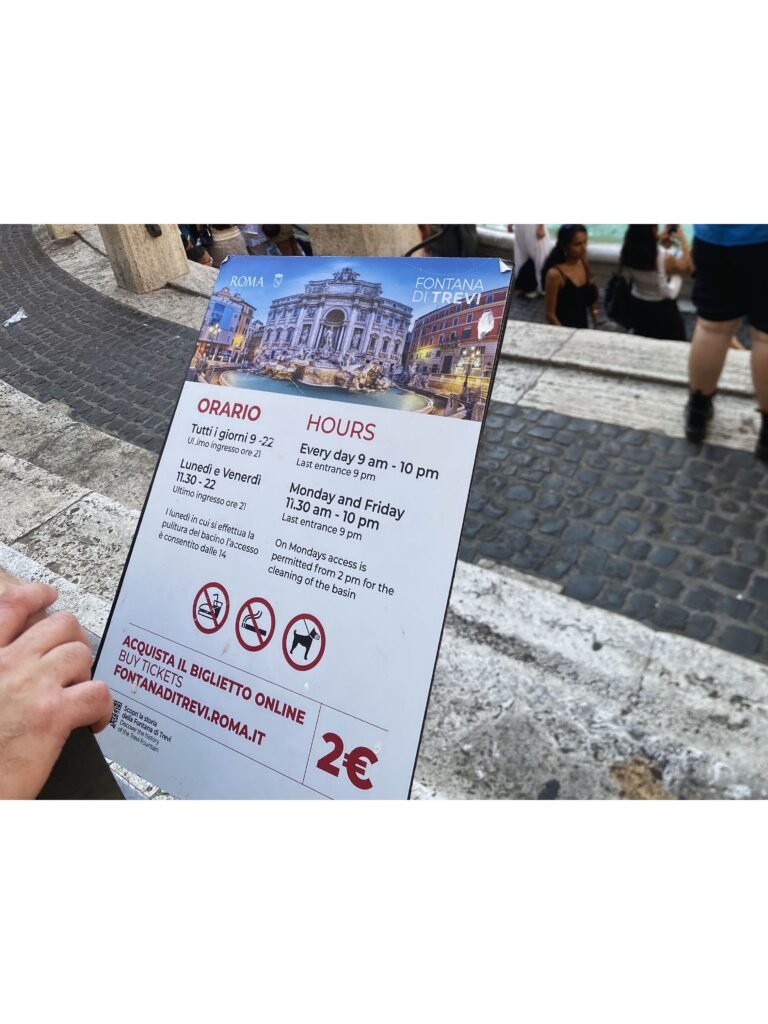
💡 Pro-Tip: As of 2026, a €2 ticket is required for close-up basin access during peak hours (9 AM–10 PM). Want it completely for free and without the massive crowds? Arrive before 9:00 AM or after 10:00 PM. You’ll get that perfect, uninterrupted shot and a stress-free coin toss!
Don’t forget to toss your coin with your right hand over your left shoulder to ensure your return to the Eternal City
🎬 Lights, Camera, Rome: The Fountain on Screen
Beyond its history, the Trevi Fountain is a certified Hollywood celebrity. For example, it played a major role in classics like Roman Holiday (1953).
However, its most legendary cinematic moment belongs to Federico Fellini’s La Dolce Vita (1960). The famous scene features actress Anita Ekberg wading into the water. She then beckons Marcello Mastroianni to join her. This sultry moment permanently cemented the fountain into global pop culture.
In addition to movies, the site hosts spectacular real-world fashion events. For instance, the fashion house Fendi celebrated its 90th anniversary here in 2016. They built a transparent glass runway directly over the water. Consequently, the models looked like they were literally walking on water.
⚠️ Traveler Warning: Do not try to recreate the La Dolce Vita scene today! Stepping foot into the water will get you a very swift, unglamorous €450 fine from the local police.
🚇 How to Get There via Public Transport
The Trevi Fountain is tucked away inside a maze of narrow cobblestone alleys. Because it sits in a pedestrian-only zone, you cannot drive directly to it.
📍 How to find it: if you are walking around in the city in Indiana Jones mode, set your GPS to 41°54′03″N and 12°28′59″E
Fortunately, navigating the city via public transit is incredibly simple.
- By Metro: First, you can take Line A (the Orange Line). Then, hop off at the Barberini station. From there, it is an easy 8-minute walk down Via del Tritone. Alternatively, exit at the Spagna station and walk south for 10 minutes.
- By Bus: Because the fountain is highly central, dozens of transit buses drop off nearby. Look for routes heading toward Piazza Venezia or Via del Corso. Good options include buses 62, 63, 83, and 85. Finally, hop off at Largo Chigi and walk three minutes.
🗺️ Unmissable Things to Do Around the Fountain
Once you’ve tossed your coin (right hand, left shoulder, you know the drill!), don’t just rush off. The surrounding neighborhood is packed with hidden gems and world-class sights:
- Explore Vicus Caprarius: This fascinating archaeological site sits just a few steps away. You can journey underground to explore ancient Roman apartments. Additionally, you will see the labyrinth of pipes where the Aqua Virgo aqueduct still flows.
- Visit the Pantheon: Walk about eight minutes west through the winding alleyways. Soon, you will stumble upon the best-preserved ancient building in Rome. Standing under its massive concrete dome is unforgettable.
- Stroll to the Spanish Steps: A quick 10-minute walk north brings you to Piazza di Spagna. Sit on the famous steps and enjoy the lively atmosphere.
- Grab a Slice at Piccolo Buco: This tiny, legendary pizzeria is located just one block away. They serve incredible pies with massive, airy crusts. However, you must get there early because lines form quickly.
- See the Column of Marcus Aurelius: Head over to Piazza Colonna, which is just five minutes away. Here, you can marvel at a towering victory column standing since 193 AD.
Do you have more time to visit Rome? Discover all the best things to see and do while in the Roman city
Pingback: Free Rome: The Ultimate Guide to the Soul of the Eternal City - The DAYDREAMDIVER